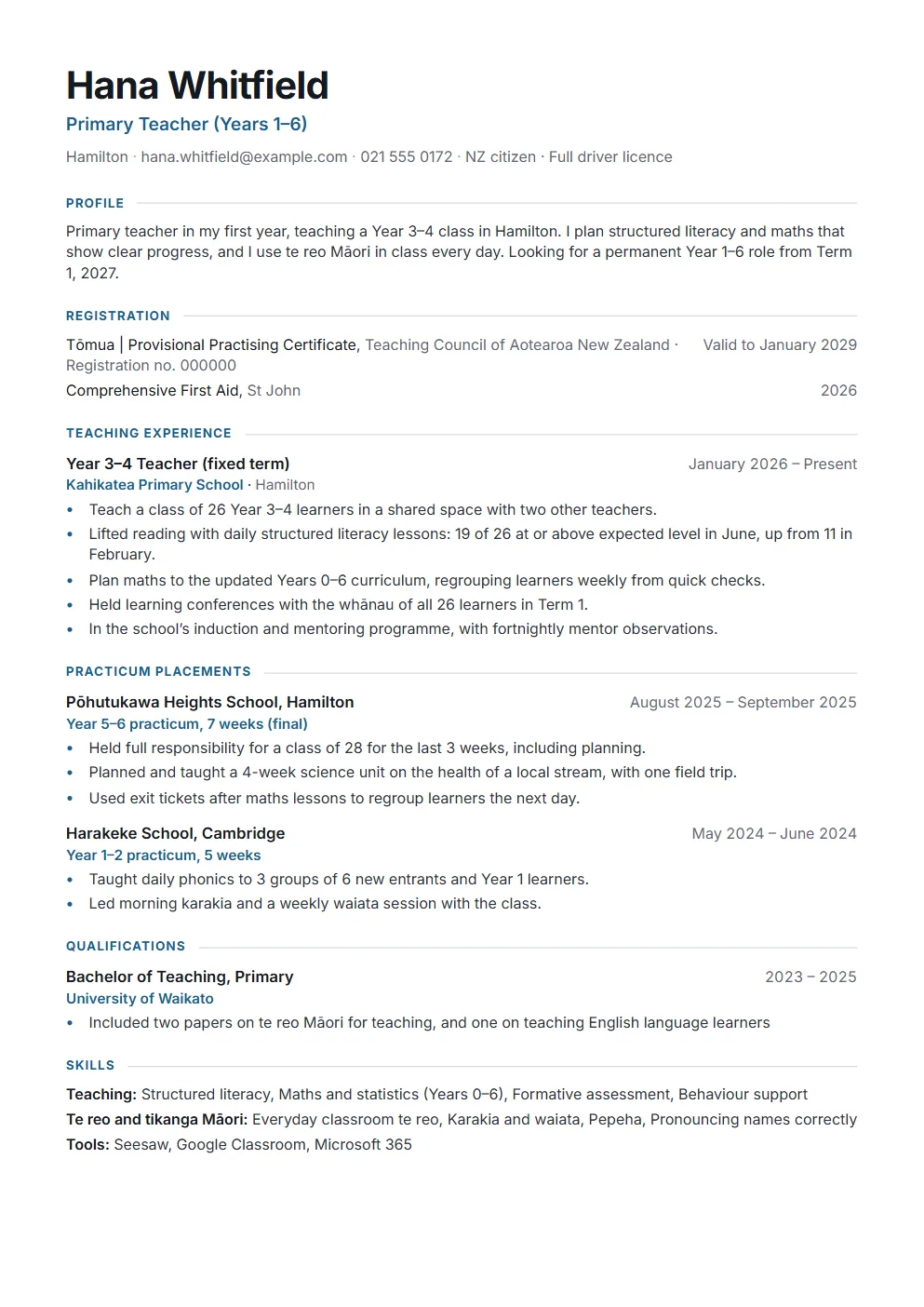
New Zealand teacher CV template
An A4 CV for early childhood, primary and secondary teachers in New Zealand. Your Teaching Council registration and practising certificate come straight after your profile, followed by the schools you’ve taught in and, if you’re a beginning teacher, your practicums.
- Word and PDF
- A4
- No sign-up, no watermark
What’s in it, in order
- Name, phone and email, then your work rights
- Profile: what and who you teach, and the role you want
- Registration: certificate type, registration number and the date it runs to
- Teaching experience by school, with year levels, subjects or age groups
- Practicum placements, for beginning teachers
- Qualifications, including how NZQA assessed an overseas one
- Skills, with te reo and tikanga Māori on their own line
- Professional learning, extracurricular activities and other work
- Three referees: a principal or leader, a mentor and an associate teacher or colleague
The blank template
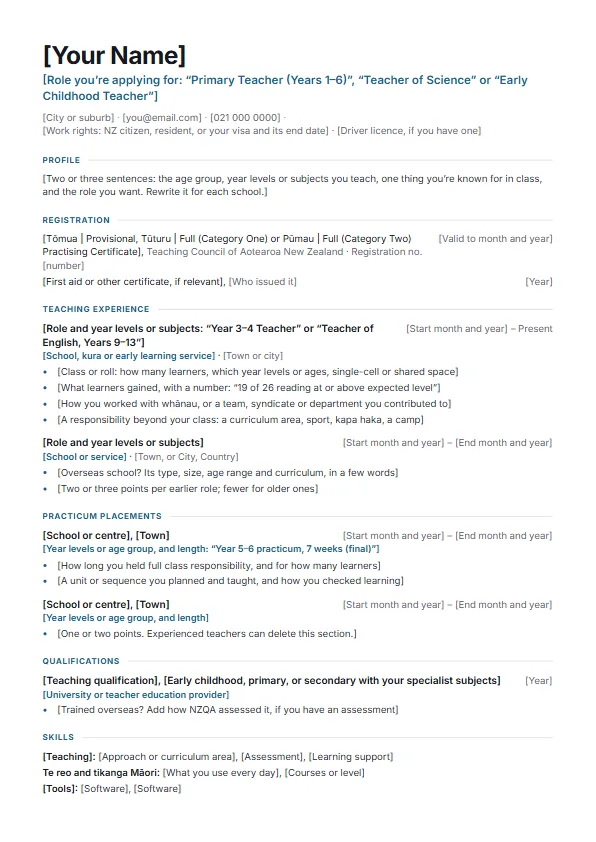 Template (Word)
Also available: the example as a Word file.
Already have a CV?
See your CV in this teacher layout
Upload or paste the CV you have now, even an old one from teacher training. About 20 seconds later it appears in this layout: A4, registration near the top, then your schools and practicums, each page shown as it will print. We copy your words as you wrote them and never rewrite them. Save it, download a PDF or Word file, then add what principals look for first: your certificate type, year levels and what your learners gained.
Updated October 2026. Sources are listed at the end.
Put your registration and certificate near the top
Registration with the Teaching Council of Aotearoa New Zealand shows you meet the profession’s standards, but registration alone doesn’t let you teach. You also need a current practising certificate. A principal checks this before anything else, so put it straight after your profile.
- Use the Teaching Council’s names: Tōmua | Provisional Practising Certificate, Tūturu | Full Practising Certificate (Category One), or Pūmau | Full Practising Certificate (Category Two).
- Add your registration number and the month your certificate runs to. Certificates last three years, and school application forms often ask for the number. Your status is also on the Teaching Council’s public register.
- If your certificate is due for renewal, say you’ve applied. If you’re still waiting on your first one, write “applied for” and the month.
- A Limited Authority to Teach is not a practising certificate. If that’s what you hold, use its own name.
- Leave your police vet off. The Teaching Council vets teachers as part of certification, and the Ministry of Education tells schools to rely on that vet and add their own risk assessment under the Children’s Act.
Beginning teachers: give each practicum its own entry
New graduates, and every overseas-trained teacher, start on a Tōmua certificate. To move to Tūturu you complete an induction and mentoring programme, usually over at least two years in New Zealand while teaching at least 0.5 of full time, and your mentor and professional leader endorse you. Principals hiring a beginning teacher know they’re signing up to support you, so they read your practicums for signs you’ll grow fast.
- List each placement under Practicum placements: the school or centre, the year levels or age group, how many weeks, and the dates.
- Say how long you held full responsibility for the class, and for how many learners.
- Name a unit you planned and how you checked what learners took from it.
- Put relief teaching, teacher aide work or holiday programmes in too. They show you can run a room.
- Once you have a year or two of your own teaching, cut practicums to one line each, or remove them.
Early childhood, primary and secondary CVs are not the same
Early childhood teachers work in kindergartens, education and care centres, kōhanga reo and other services, and need an early childhood teaching degree or graduate diploma. Licensed services follow Te Whāriki, through either the Te Ara Whānui or Te Ara Māori pathway. Write about the ages you’ve worked with, how you plan from children’s interests, and how you share learning with whānau.
Primary teachers teach children aged about 5 to 13. Give your year levels, class size and any curriculum area you lead. From 2026 schools use the updated English and maths and statistics content for Years 0–10, and science and social sciences follow for Years 0–8 in 2027. If you’ve taught the new content, say so in plain words.
Secondary teachers teach one or more specialist subjects to Years 9–13. Put the subjects and levels in your job title line. If you quote NCEA results, make clear they’re your class’s results, and give the number of students.
Show what learners gained, not your duties
Every teacher plans, teaches and assesses, so a list of duties tells a principal nothing new. Each bullet should say what you did and what changed for learners.
The Teaching Council’s 2026 Standards for the Teaching Profession make a good checklist. Schools use them in the professional growth cycle from 2026, and they become the basis for re-certification from 2027. There are eight, including knowing the content and how to teach it, assessing and reporting on learning, professional learning, and professional relationships. You don’t need to quote standard numbers; just make sure your bullets give evidence for several of them.
- Progress: “19 of 26 reading at or above expected level in June, up from 11 in February.”
- Assessment: how you found out what learners knew, and what you changed next.
- Whānau: learning conferences, home learning, how many families you reached.
- The wider school: sport, kapa haka, cultural groups, camps, a team you lead.
- Professional learning: the programme, and what you now do differently because of it.
Te reo Māori, tikanga and Te Tiriti
The first of the 2026 Standards is Te Tiriti o Waitangi partnership. One of its focus areas asks teachers to practise and develop their use of te reo and tikanga Māori, including to engage well with Māori learners and their whānau. The Teaching Council’s guide to the Standards says this is about ongoing growth, and it doesn’t set a fixed level of fluency.
So be specific and honest. Name what you use in class every day, the courses you’ve done, and how you work with whānau, hapū or iwi. “Everyday classroom te reo, karakia and waiata; Level 2 evening course in 2025” is more useful than “fluent” when you’re not. Some teachers add a short pepeha; that’s a personal choice, not a requirement.
Overseas-trained teachers
You need registration and a practising certificate before you can teach here. NZQA assesses your qualification through an International Qualification Assessment. The Teaching Council also asks for evidence of English language competency, overseas police clearance, proof of identity and letters from past employers. It usually takes 6 to 12 weeks, longer if a panel reviews it, and you’ll start on a Tōmua certificate.
- Say where you’re up to: “Registered, Tōmua certificate” or “Registration applied for, May 2026”.
- Describe each overseas school in a few words: type, roll, age range and curriculum.
- Give learners’ ages alongside your country’s grade names, because year levels don’t line up between countries.
- The Ministry of Education’s workforce site reports high demand for secondary STEM teachers, te reo Māori teachers, rural schools and relievers. If that’s you, make it obvious.
- Put your visa or work rights in the line under your name.
Mistakes to avoid
- Leaving out your certificate type, registration number or the date it runs to, so a school has to chase you before it can shortlist.
- Calling a Tōmua certificate “full”, or a Limited Authority to Teach a practising certificate.
- Listing duties like “planned lessons and marked work” instead of what your learners achieved.
- Writing that you’re fluent in te reo Māori when you use classroom phrases. Say exactly what you use.
- Using another country’s grade names or exam terms without the learners’ ages or a short explanation.
- Sending the same CV to a kindergarten and a secondary school. Rewrite it for the age group and curriculum.
Questions
How long should a teacher CV be in New Zealand?
There’s no official length. Two A4 pages suits most teachers, and a beginning teacher can usually fit everything in one and a half. If you’ve taught for many years, shorten older roles to a line or two rather than adding a third page.
Do I need a cover letter as well?
Plan on writing one unless the ad says otherwise. Some schools also have their own application form, asking for your registration number, three referees and declarations about your history. Use the letter to link your experience to that school, its learners and the role in the ad.
Who should my referees be?
A school’s own application form may ask for three, and some schools contact referees before shortlisting. Choose people who have seen you teach: your principal or a senior leader, your mentor teacher or head of department, and, for a beginning teacher, the associate teacher from your final practicum. Ask each one first, and give their role and how they know you.
Should I put my police vet on my CV?
No. The Teaching Council police vets teachers when it issues or renews a practising certificate, so your certificate already covers it. The school still does its own safety check and risk assessment before it appoints you.
What changes for an early childhood teacher CV?
Lead with your registration and certificate, as for any teacher, then the services you’ve worked in and the ages you taught. Refer to Te Whāriki rather than the school curriculum, and show how you plan from children’s interests and share learning with whānau.
Can I apply before my practising certificate comes through?
Yes. Say on your CV that you’ve applied and when, so the school can plan around it. You must hold a current practising certificate before you start teaching.
Sources
- Teaching Council: Types of practising certificates
- Teaching Council: What is registration and certification?
- Teaching Council: When to apply for full certification
- Teaching Council: Register to teach as an overseas teacher
- Teaching Council: Move to the 2026 Standards
- Teaching Council: A guide to the standards and focus areas of the 2026 Standards (PDF)
- Ministry of Education: Police vets in schools and kura
- Ministry of Education: Who needs to be safety checked in a school
- Ministry of Education: New timeframe for the final national curriculum
- Ministry of Education: Early learning curriculum framework
- Education Workforce: Get ready to move to New Zealand
- Tahatū: Primary school teacher
- Tahatū: Secondary school teacher
- Tahatū: Early childhood teacher
- Puketapu School: Teacher job application form (2025)
- University of Auckland: Practicum
General guidance. Always follow what the job ad asks for. Every name, employer and number in the example is made up.