Nursing resume template for Australia
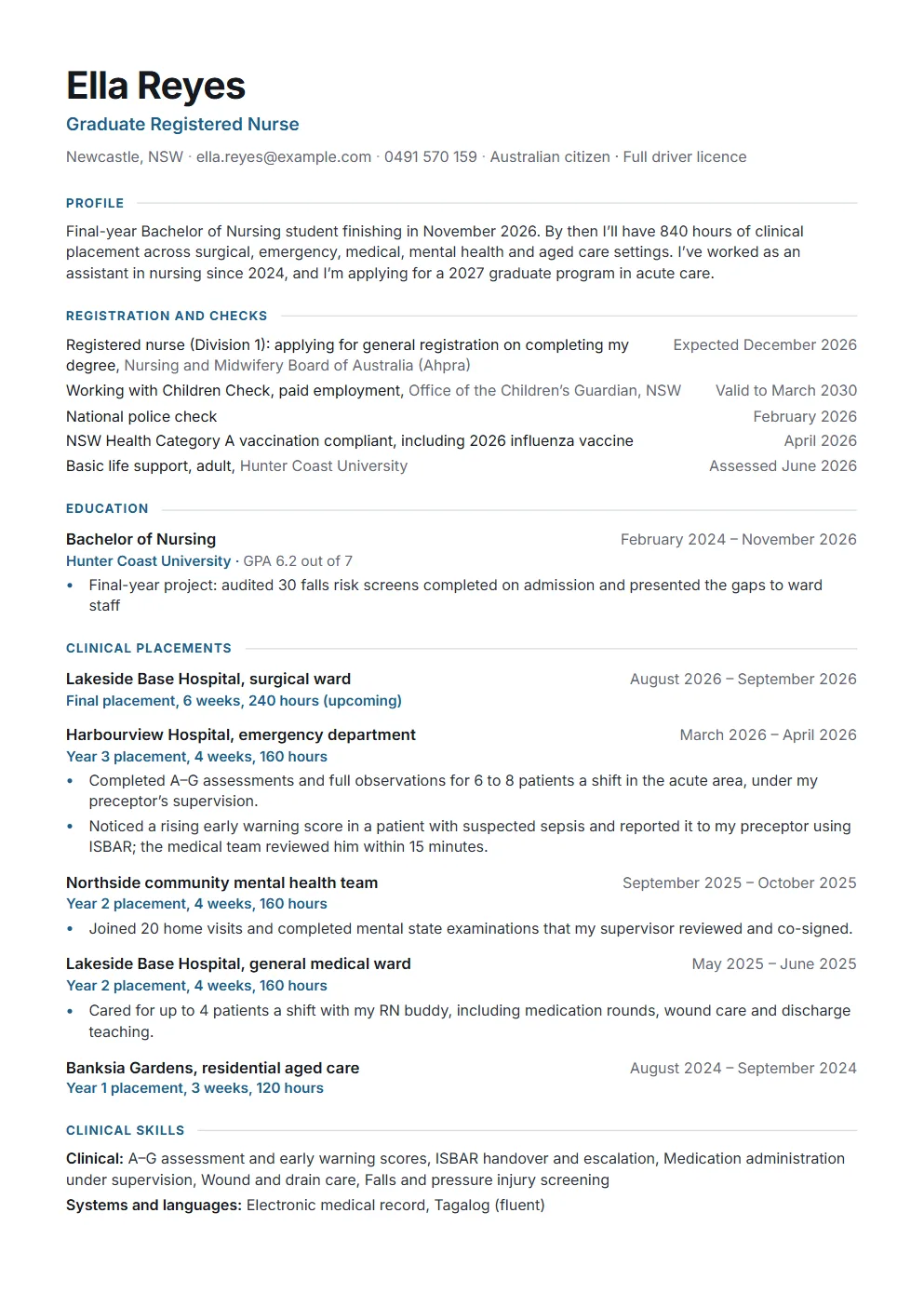
An A4 resume for registered nurses and graduate nurses, with your registration and pre-employment checks right under your profile and your clinical placements set out the way graduate programs ask for them. The example is a final-year student applying for a 2027 graduate program.
- Word and PDF
- A4
- No sign-up, no watermark
What’s in it, in order
- Name, phone, a personal email, then your work rights
- Profile: your registration or finish date, your hours or years, and the role you want
- Registration and checks: division, type, number, plus WWCC, police check, vaccinations and life support
- Education, with your GPA or WAM
- Clinical placements: facility, ward, weeks and hours, including upcoming ones
- Clinical skills, then systems and languages
- Employment history, such as assistant in nursing or RN roles
- Professional development, then three referees
The blank template
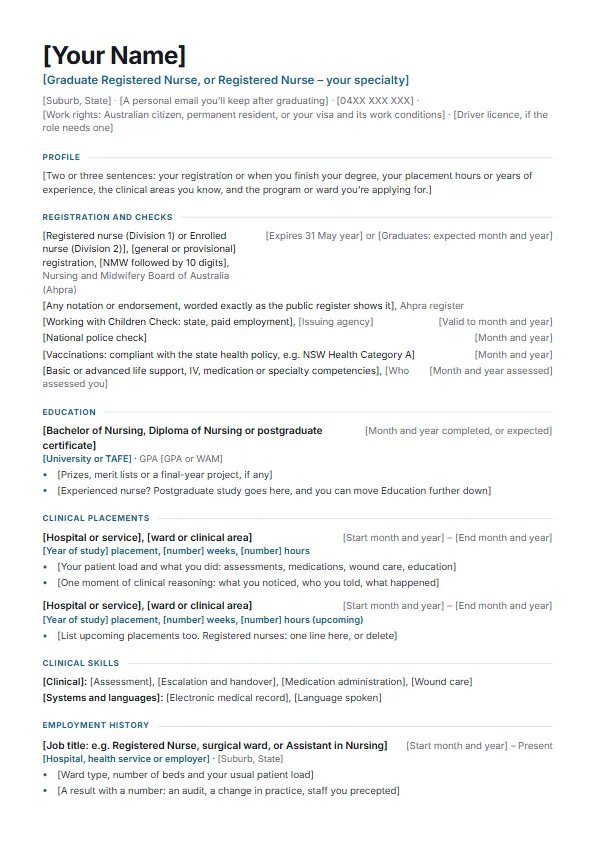 Template (Word)
Also available: the example as a Word file.
Already have a resume?
See your resume in this nursing layout
Upload your current resume or paste it in, whether it’s a student draft or ten years on the wards. Around 20 seconds later it shows in this layout on A4, with registration and checks near the top and placements in their own section, each page as it will print. Nothing is reworded: every line stays exactly as you wrote it. Save it to download PDF or Word, then fill the gaps panels look for first, like your registration number, placement hours and a clinical referee.
Updated October 2026. Sources are listed at the end.
Registration: what to write and what employers check
The Nursing and Midwifery Board of Australia (NMBA) registers nurses, and Ahpra keeps the public register. Nurses sit in one of two divisions: Registered nurse (Division 1) or Enrolled nurse (Division 2). On your resume give your division, your registration type (general or provisional, for example), your registration number and when it expires. Ahpra numbers are three letters followed by ten digits; for nurses the letters are NMW.
Employers check it themselves. NSW Health’s applicant guide says your registration status is verified independently before an offer, and Ahpra sends employers to the register to confirm it. It shows your division, type, expiry date and any conditions, notations or endorsements, so copy that wording exactly.
Still studying? Students are registered too, but the NMBA keeps the student register confidential, so there’s no number to quote. Write when you finish and when you expect registration. Ahpra suggests applying up to 90 days before you complete your course, and you can’t work as an RN until your name appears on the register.
Trained overseas? The NMBA assesses your qualifications and assigns you to a stream: some nurses can apply for registration straight away, others must pass an outcomes-based assessment, a multiple-choice exam followed by a clinical exam (OSCE). Since 23 April 2025, a separate standard gives a quicker route to experienced RNs who registered and practised in a country on the NMBA’s approved list; the ANMF’s journal reported this needs at least 1,800 hours of practice. Put the stage you’ve reached at the top, then your overseas registration and the regulator’s name.
Graduate programs: check whether they even read a resume
The big state programs handle your history in different ways, so read the instructions first.
- NSW Health GradStart takes a CV covering your education and work history, an academic transcript (an unofficial one is fine) and an NSW Working with Children Check number for paid work. There’s no cover letter: the six selection criteria answers carry most of the weight.
- Queensland Health’s graduate program doesn’t take a resume at all. Its online form asks for the same facts in fields: your qualification and GPA or WAM, each year’s placements with location, clinical area and weeks, and your latest work or volunteering. Keep your resume open while you fill it in.
- Victoria’s GNMP Match, run by PMCV, needs two applications: one to PMCV, and one to each health service you preference (one to six). Each service sets its own documents. The Royal Children’s Hospital, for example, wants a CV of up to three pages listing every completed and upcoming placement with the facility, weeks and hours, plus your two latest clinical appraisals. It says no photo is needed and secondary school can be left off.
- Eligibility differs too. The Victorian Match is only for first-time graduates who trained in Australia or New Zealand; Queensland takes graduates of the past two years from Australian or overseas courses the NMBA recognises.
Clinical placements are your experience
Until you’ve worked as an RN, placements are your strongest evidence, so they get their own section above any other jobs. For each one give the facility, the ward or clinical area, your year of study, and the length in weeks and hours. Graduate programs recruit mid-year, so your final placement may still be ahead: list it anyway and mark it as upcoming.
Under each placement, add a line or two on what you did: your patient load, the assessments and skills you practised, and a time you noticed something and acted on it. Be clear about scope. “With my preceptor” or “under supervision” is honest and expected; implying you ran a patient load alone on placement is not.
After a year or two on the wards, shrink placements to one line and let your employment history do the work: ward type, beds, usual load, then results.
Write bullets around the NMBA standards
The NMBA’s seven Registered nurse standards for practice apply to every RN in every setting, and graduate panels and position descriptions draw on them. Don’t quote standard numbers on a resume. Just check that your bullets, taken together, show assessment, planning, safe care, evaluation, teamwork and keeping your practice current. Enrolled nurses have their own standards for practice and should use those.
- Assessment: “Completed A–G assessments and full observations for 6 to 8 patients a shift.”
- Escalation: “Reported a rising early warning score to my preceptor using ISBAR; medical review within 15 minutes.”
- Quality improvement: “Audited 30 falls risk screens on admission and presented the gaps to ward staff.”
- Capability: list professional development with dates and hours. Registered and enrolled nurses need at least 20 hours of CPD each registration year, and routine yearly CPR or fire training doesn’t count unless it includes new learning.
Checks and mandatory training
List the checks you already hold, with expiry dates. Which apply depends on the state and the role.
- Working with Children Check. NSW Health wants an NSW clearance for paid work, and GradStart rejects volunteer and interstate checks.
- Police check. NSW Health asks preferred applicants to consent to a national criminal record check, and overseas applicants for a police clearance from their home country.
- Vaccinations. NSW Health’s policy for clinical (Category A) staff and students covers diphtheria, tetanus, pertussis, hepatitis B, measles, mumps, rubella, varicella and influenza, plus a TB assessment, with evidence before you start. Queensland’s graduate form asks your status for hepatitis B, MMR, pertussis and varicella without uploads. One line on your resume is enough.
- Role-based screening. A GV Health registered nurse position description lists police, Working with Children, NDIS worker and aged care screening as pre-employment checks where they apply to the job.
- Life support and competencies. Listing your latest basic or advanced life support assessment, and IV, medication or specialty competencies, with dates, is common practice rather than a published rule.
Referees: clinical first
Programs differ on who counts as a referee. Ask each person first, confirm their title and email, and send them the position description. Listing three, as the example does, covers a clinical referee and an employer.
- GradStart: two referees. One must be clinical, in a supervising role such as nurse unit manager, clinical nurse educator or clinical facilitator; the other someone who has employed you, paid or unpaid.
- Victorian Match: two clinical referees, each an RN or midwife with at least a year’s experience who worked closely with you. A preceptor can qualify; a non-clinical referee can’t.
- NSW Health RN jobs: at least two referees, asked for at interview, one of whom must be your current supervisor or manager.
Mistakes to avoid
- Writing “Ahpra registered” with no division, type, number or expiry, or details that don’t match the public register.
- Listing a placement as “4 weeks, hospital” with no facility, clinical area or hours, which is exactly what graduate applications ask for.
- Leaving out your final placement because it hasn’t started yet. Mark it as upcoming.
- Implying you practised independently as a student. Say what you did and who supervised you.
- Describing a patient in a way someone could recognise. Keep bullets clinical and anonymous.
- Applying with your student email. Queensland Health and the Royal Children’s Hospital both ask for a personal address you’ll still use after graduating.
Questions
Should I put my Ahpra registration number on my resume?
Yes, with your division, registration type and expiry date. Employers check the public register anyway, and the number lets them find you straight away. Queensland Health’s graduate form asks for it if you’re already registered. If you aren’t registered yet, give the date you expect to be.
How long should a graduate nurse resume be?
Two pages suits most graduates. If a service sets a limit, follow it: the Royal Children’s Hospital in Melbourne allows up to three pages for its graduate program, and Queensland Health’s program uses an online form instead of a resume.
Do I list every clinical placement?
As a graduate, yes, including upcoming ones, with the facility, clinical area, weeks and hours. After a year or two working as a nurse, cut them to one line or remove them.
Do I attach my vaccination records?
Not to your resume. One line saying you meet the state health service’s requirements is enough. NSW Health asks for evidence before you start work, and Queensland Health’s graduate form only asks you to declare your status.
Can an enrolled nurse or assistant in nursing use this template?
Yes. Enrolled nurses write Enrolled nurse (Division 2) in the registration line, with any notation exactly as the register shows it, and frame bullets around the NMBA’s Enrolled nurse standards for practice. Assistants in nursing aren’t registered, so remove that line and keep the checks, skills and employment sections.
Should I include a photo?
No, unless a service asks for one. The Royal Children’s Hospital says its graduate CV doesn’t need a photo, and NSW Health says personal details such as age and marital status don’t belong on a resume.
Sources
- Nursing and Midwifery Board of Australia: Registered nurse standards for practice
- Nursing and Midwifery Board of Australia: Fact sheet: Registration as a nurse or a midwife
- Nursing and Midwifery Board of Australia: Fact sheet: Continuing professional development
- Nursing and Midwifery Board of Australia: Fact sheet: Student registration
- Nursing and Midwifery Board of Australia: Qualification and registration requirements for internationally qualified nurses and midwives
- Nursing and Midwifery Board of Australia: General registration for internationally qualified registered nurses
- Ahpra: Register of practitioners
- Ahpra: Professions and divisions
- Ahpra: Graduate registration FAQ
- NSW Health: GradStart selection criteria and documents
- NSW Health: Information for applicants
- NSW Health: Occupational assessment, screening and vaccination FAQ
- Queensland Health Careers: How to apply for the graduate program
- Queensland Health Careers: How to submit your application (graduate program)
- PMCV: Graduate Nursing and Midwifery Program Match, candidate handbook 2026–2027
- The Royal Children’s Hospital Melbourne: Graduate nurse program, how to apply
- GV Health: Registered Nurse position description
- ANMJ (Australian Nursing and Midwifery Federation): Overseas nurses fast-tracked to work in Australia
General guidance. Always follow what the job ad asks for. Every name, employer and number in the example is made up.