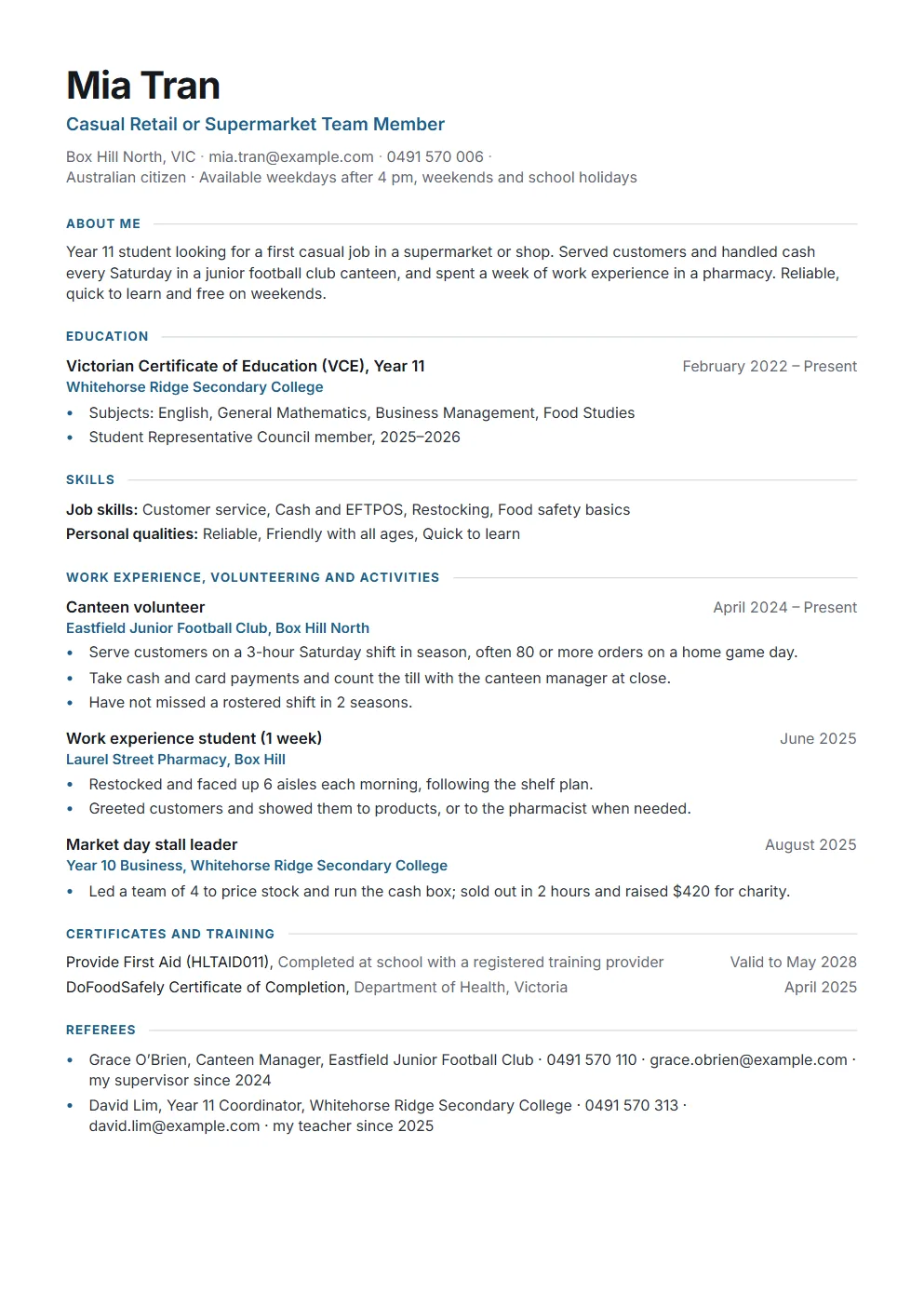
Student resume template for your first job in Australia
A one-page A4 resume for high school, TAFE and uni students applying for a first casual or part-time job, even with no experience. Education comes first, then what you’ve done outside class: work experience placements, volunteering, sport and school events. Download the Word file and swap each bracketed prompt for your own details.
- Word and PDF
- A4
- No sign-up, no watermark
What’s in it, in order
- Name, mobile, email, suburb and state, work rights and when you can work
- About me: two or three lines, changed for each job
- Education: your school or course, year level and achievements
- Skills: job skills and personal qualities
- Work experience, volunteering and activities: placements, sport, school events, informal work
- Employment: any paid job (delete it if you haven’t had one)
- Certificates and training, such as first aid and food safety
- Two referees: a teacher, coach or supervisor, not a relative
The blank template
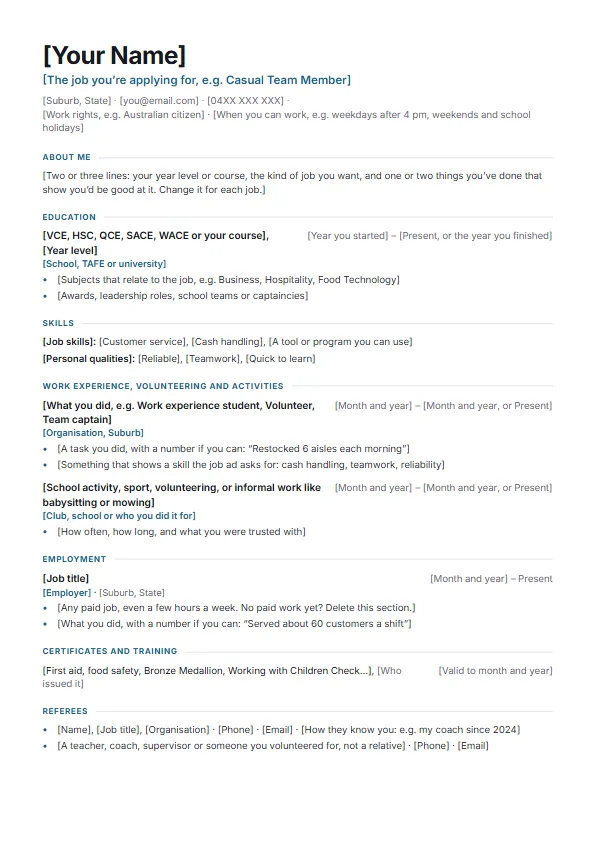 Template (Word)
Also available: the example as a Word file.
Already have a resume?
See your resume in the student layout
Started a resume at school or with a careers adviser? Upload it or paste the text. In about 20 seconds it appears in this template on A4, with education near the top and your activities in a section of their own. Nothing is reworded: we copy your words exactly. Save it and you can download a PDF or Word file, then fill any gaps, like the hours you can work or a second referee.
Updated October 2026. Sources are listed at the end.
What goes first when you haven’t had a job
Workforce Australia says that if your work experience is limited, your education can come ahead of your employment history. For a student that means: contact details, a short opening statement, education, skills, then what you’ve done outside the classroom, with any paid job after that.
One page is enough. Youth Central’s sample resumes for students with no paid work fit on a single page, and it says that’s fine when you’re just starting out. Headspace suggests that if your resume only just runs onto a second page, you reformat it back onto one.
Under education, give your school, the certificate you’re working towards (VCE, HSC, QCE, SACE, WACE or another) and your year level. Youth Central says results aren’t needed unless they show you suit the job, but a few achievements are worth a line each: class captain, SRC, awards, school teams.
For the opening statement, Youth Central suggests leaving out “I”: write “Served customers at…” rather than “I served customers at…”. Headspace calls it an objective and says you can move it into your cover letter if the ad asks for one.
Turn school, sport and volunteering into evidence
Experience doesn’t have to be paid. Workforce Australia counts volunteer work. Youth Central lists school work experience, placements and volunteering as things to use when you haven’t had a job, and its YouthNav guide counts informal help such as babysitting or mowing a neighbour’s lawn. Headspace adds helping out in a family business.
The template gives these their own section, set out like jobs: what you did, where, when, and two or three points. Write the points the way you’d describe a shift: what you handled, how often, how many. “Took cash and card payments at the club canteen every home game” proves more than “good communication skills”.
- Work experience placement: the tasks you did, who you helped and anything you were trusted to do alone.
- Volunteering: say how long and how often. A regular commitment shows you turn up.
- Sport and teams: training, captaincy, umpiring or coaching younger players.
- School events: stalls, fundraisers and productions, especially where you handled money, stock or people.
- Informal work: babysitting, pet sitting, mowing, tutoring younger students.
Say when you can work
Casual jobs run on a roster, so a manager’s first question is often whether your hours fit theirs. None of the government guides we read sets a rule on where availability goes. A line under your contact details, such as “Available weekdays after 4 pm, weekends and school holidays”, is a common way to do it. Only list hours you can really work around school, sport and exams.
The Fair Work Ombudsman says the minimum age to start work depends on your state or territory, and lists who to contact in each. Working during school hours usually means you’ve reached the minimum school leaving age or finished the minimum year of schooling, which states also set.
Certificates and checks young people often need
Workforce Australia asks for relevant licences and certificates, with when each one expires. For first jobs, these are the ones that come up most.
- First aid: give the course name and code, such as Provide First Aid (HLTAID011), and the date it’s valid to.
- Food safety: DoFoodSafely is a free online course from Victoria’s Department of Health. Passing its test gives you a certificate of completion. It isn’t an accredited qualification, but it shows a café or takeaway you know the basics of hygiene and allergens.
- Responsible Service of Alcohol (RSA): NSW requires it for anyone who sells, serves or supplies alcohol. In Victoria, under-18s can do the course but must wait until 18 to serve, and can only do tasks at a licensed venue that don’t involve supplying alcohol. Check your own state’s rules before you pay for a course.
- Working with Children Check: needed for jobs like swim teaching, coaching or tutoring. In NSW, people under 18 don’t need one. Other states set their own rules, so check before you apply.
Referees when you’ve never had a boss
If you’ve never had a job, Workforce Australia suggests a character reference from a teacher, sports coach, neighbour or community group leader. Youth Central adds your work experience employer, a librarian or principal, and people you’ve volunteered for, and says it’s best not to use friends or family. If you’ve worked in a family business, Workforce Australia suggests finding a referee there who isn’t related to you.
Before you list anyone, ask them, check how they spell their name, and get their job title and the phone number or email they’d like you to use. Job Jumpstart suggests at least two, and Youth Central says two is usual unless the ad asks for a different number. Youth Central also suggests letting your referees know you’re job hunting so a call doesn’t surprise them.
Sources differ on contact details. Workforce Australia says to include them. Youth Central says you can give names and job titles and offer the details when asked. Headspace says to include referees if the ad asks for them. The template includes them, so a manager hiring quickly can call straight away.
Applying: in person, online and the cover letter
The Australian Government’s Job Jumpstart site suggests contacting employers directly even when they aren’t advertising, and asking them to keep your resume in case something comes up. In its employer surveys, 1 in 5 vacancies were filled by word of mouth rather than an ad. If a business only takes online applications, use its form.
Youth Central describes a cover letter as a one-page introduction and says half a page can be enough. Use it for anything specific to that job, so your resume can stay much the same across similar applications.
You may be asked to do a trial shift. The Fair Work Ombudsman says an unpaid trial is only allowed for as long as it takes to show the skills needed, from an hour up to one shift, and you should be told beforehand that it’s unpaid.
Mistakes to avoid
- Leaving an empty “Work history” heading. Drop it and let your activities section show what you’ve done.
- Listing qualities with no proof, such as “hard-working, reliable, team player”. Tie each one to something you actually did.
- Using a parent, sibling or best friend as a referee. Youth Central and Workforce Australia both advise against it.
- Putting your tax file number on your resume. The ATO says someone with your TFN can steal your identity, and only some organisations, such as your employer, can ask for it.
- Offering hours you can’t keep once school, sport and exams are counted.
- Putting your contact details only in the page header. Youth Central says some recruitment software can’t read headers, so keep them in the body too.
Questions
What if I have no work experience at all?
Use what you have: your education, school activities, sport, volunteering and informal work like babysitting or mowing. Youth Central’s samples for Year 10 and VCE students with no paid work use exactly these. For referees, ask a teacher, coach or someone you’ve volunteered for to give you a character reference.
Should I put my age on my resume?
You don’t have to. Youth Central says your resume doesn’t need your birthdate, with a possible exception if it would help, for example when an employer is looking for someone young. Junior pay rates for under-21s depend on age, according to the Fair Work Ombudsman, so if an application form asks for your date of birth, answer it there.
How old do I have to be to get a job in Australia?
It depends on your state or territory. The Fair Work Ombudsman doesn’t give one national age; it lists the agency to contact in each state and territory. Working during school hours usually needs you to be of minimum school leaving age or to have finished the minimum year of schooling.
Do I need a tax file number before I apply?
Not to apply, and it doesn’t go on your resume. The ATO says you should have a TFN to get a job, or you’ll pay more tax. It’s free, you can apply at any age, and it should arrive within 28 days, so apply early; Your Career’s school leavers kit lists it among the first steps. Your employer can ask for it when you start.
How long should a student resume be?
One page is fine when you’re starting out, according to Youth Central. If you add a lot of activities it can run to two pages, but Youth Central says three means you’ve included too much.
Should I use the same resume for every job?
Keep one main version, then adjust it. Youth Central says to tailor your opening statement and skills to each job, and headspace suggests using words from the job ad where they honestly fit. A supermarket and a café want slightly different things.
Sources
- Write a resume, Workforce Australia (Australian Government)
- Youth Central (Victorian Government): How to write a resume
- Youth Central: Sample resume, VCE and no work experience
- Youth Central: Sample resume, Year 10 or earlier and no work experience
- Youth Central: Choosing a referee
- Youth Central YouthNav: How to write a resume
- Job Jumpstart (Australian Government): Three ways to find a job without work experience
- Job Jumpstart: Building your resume
- headspace: How to write a resume for your first job
- Your Career (Australian Government): Build your career, School Leavers Information Kit
- Fair Work Ombudsman: Minimum working age
- Fair Work Ombudsman: Pay, entitlements and working conditions for young workers
- Australian Taxation Office: What is a tax file number? (Easy Read)
- Liquor Control Victoria: Under-18s at licensed venues or locations
- NSW Government: Responsible Service of Alcohol (RSA) training
- NSW Office of the Children’s Guardian: Who needs a Working with Children Check
- DoFoodSafely (Department of Health, Victoria)
General guidance. Always follow what the job ad asks for. Every name, employer and number in the example is made up.