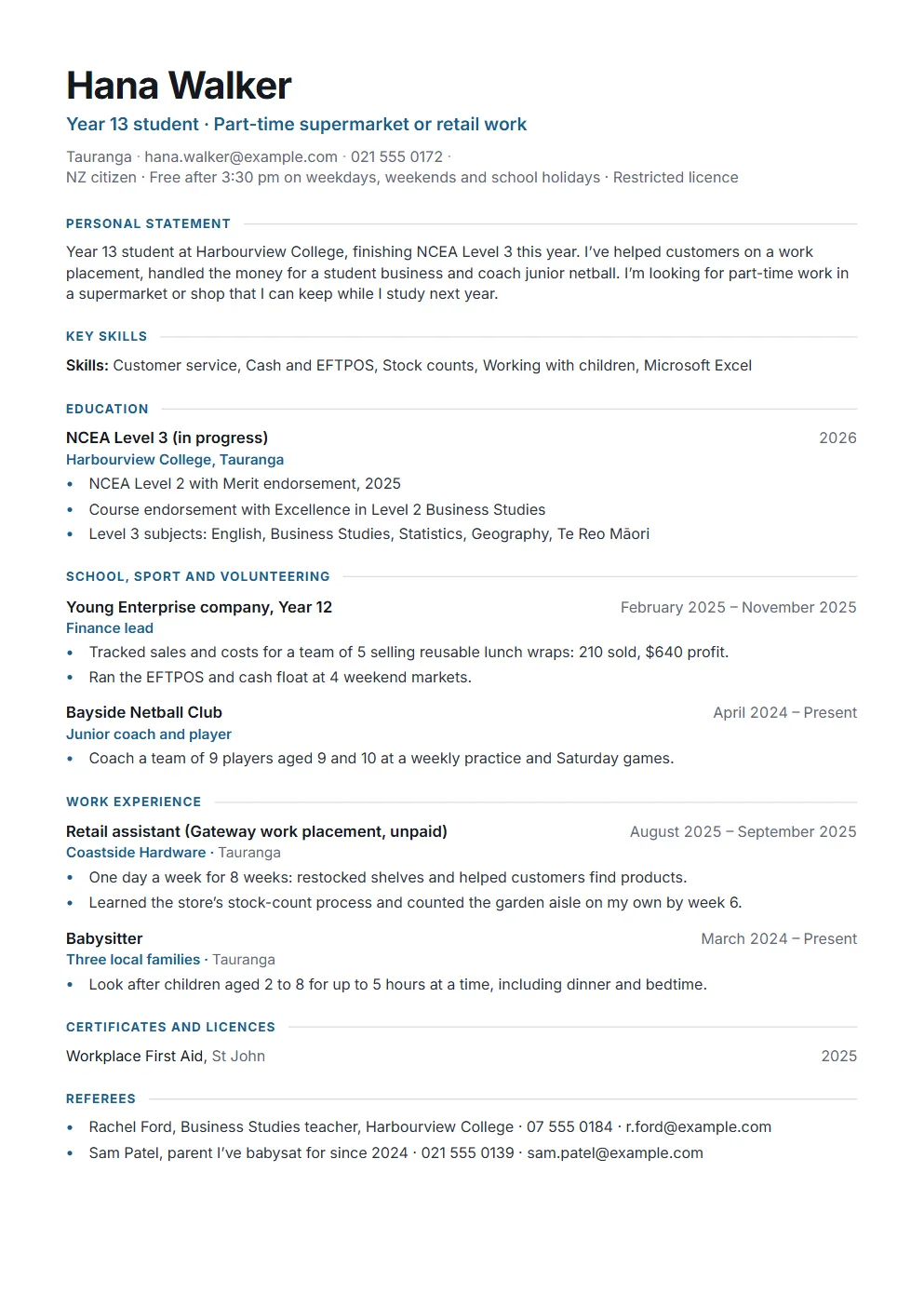
New Zealand student CV template
A one-page A4 CV for secondary and tertiary students going for a first, part-time or holiday job. Your NCEA results and school, sport and volunteer activities sit near the top, so an employer can see what you can do before they look for a job history.
- Word and PDF
- A4
- No sign-up, no watermark
What’s in it, in order
- Name, phone and email, then your work rights and the hours you can work
- Personal statement: your year or course, and the work you want
- Key skills, each one backed up further down
- Education: NCEA level, endorsements and subjects, or your tertiary course
- School, sport and volunteering: teams, clubs, leadership roles and placements
- Work experience, including babysitting and other casual jobs
- Certificates and licences, then two referees
The blank template
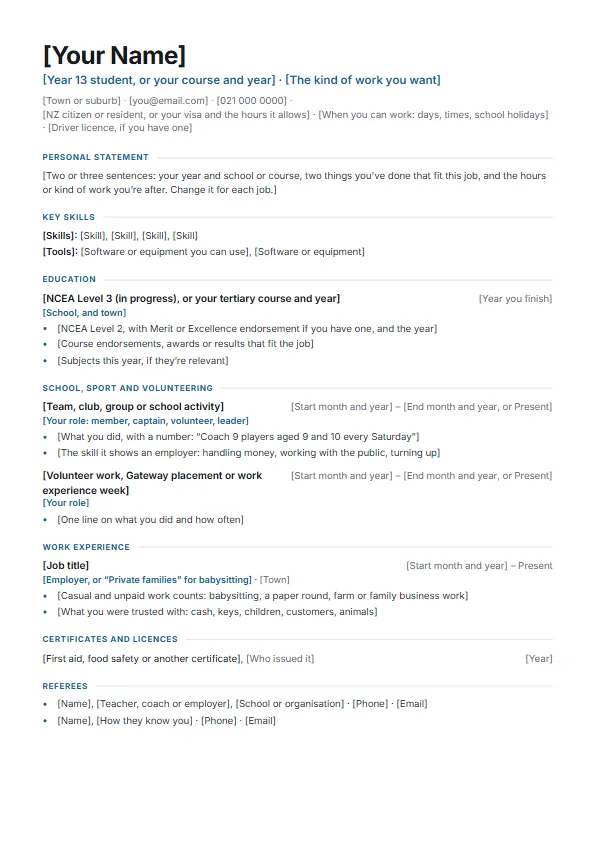 Template (Word)
Also available: the example as a Word file.
Already have a CV?
See your CV in this student layout
Upload or paste your current CV, even a school draft. About 20 seconds later it appears in this layout: A4, education and activities near the top, each page shown as it will print. We copy your words exactly and never rewrite them. Save it, download a PDF or Word file, then add what part-time employers look for first, like the days and hours you’re free to work.
Updated October 2026. Sources are listed at the end.
What goes first when you haven’t had a job
Tahatū, the government’s careers service, suggests a skills-focused CV for school leavers and anyone with little or no work experience. Its school-leaver template runs in this order, and this template follows it:
- Personal statement: a short summary of you and the job you’re after
- Key skills that match the job ad
- Education and qualifications
- Paid work, if you have any
- Workplace training and volunteer work, such as a Gateway placement or community work
- Achievements, interests and referees
How to write your NCEA results
Tahatū says to list your NCEA level, the subjects you took and any endorsements. Write the highest level you have finished, then the one you’re working on: “NCEA Level 3 (in progress)”. Employers hiring students for part-time work rarely need your credit totals or a list of standards.
Endorsements are worth naming, because they’re harder to get. NZQA endorses a certificate with Merit or Excellence when you earn 50 credits at that grade or higher, at the level of the certificate or above. A course endorsement needs 14 or more credits at Merit or Excellence in one course in a single school year, with at least 3 from internal and 3 from external assessment. Certificate endorsements are worked out each January, when external results come out, so a Year 13 applying in March can include last year’s.
At university or polytechnic, put your current course first and keep school to one or two lines. Wellington Careers and Employment suggests listing school only if you finished in the last few years, with achievements and leadership roles from your final year only.
Turning school, sport and volunteering into evidence
With no job history, your activities do the work a job history would. Tahatū says to include volunteer roles and interests that show skills an employer wants, like leadership, and to leave out common ones like watching TV. Wellington Careers and Employment adds positions of responsibility (class representative, team captain, coach) and helping out family and friends.
For each activity, write what you did, how much or how often, and what it shows. “Netball” tells an employer nothing. “Coach a team of 9 players aged 9 and 10 every Saturday” shows you turn up, you’re patient and you can talk to parents. Handling cash at a school fair, a Young Enterprise company or a Duke of Ed volunteering section all count. So does unpaid work through Gateway, which Tahatū lists as workplace learning. Student Job Search gives the same advice for students short on work history: put leadership roles, volunteering and awards forward.
Then make your key skills match. If you list “cash handling”, an activity further down should show where you did it.
Availability and work rights
Part-time employers roster around your hours, so put them on the line below your name: the days and times you can work, and whether you can do more in the school or university holidays. No official source requires this on a CV. It’s common practice, the sample application form in Tahatū’s workbook asks when you can start, and it saves the employer a phone call.
Offer only hours you’re allowed to work. Employment New Zealand says school-aged students under 16 can work only outside school hours, and not between 10 pm and 6 am.
New Zealand citizens and residents can say so in a few words. On a student visa, Immigration New Zealand allows Year 12 and 13 students aged 16 or over to work up to 25 hours a week during the school year, with written permission from their school and parents. Full-time tertiary students can usually work up to 25 hours a week in term. Check your own visa conditions and state them, for example “Student visa: up to 25 hours a week in term”.
Referees when you’ve never had a boss
Tahatū asks for at least two referees. If you’ve worked, one should be a manager or supervisor. If you haven’t, it names a sports coach, teacher or church leader as people who know you well. Its job-application workbook calls these character referees and adds community leaders and course tutors. Wellington Careers and Employment also suggests a fellow club member or a university staff member.
A parent you babysit for regularly can speak to how reliable you are. Avoid your own family and friends, which is usual practice, not a rule. Ask each referee before you name them, and tell them which job you’ve applied for. Tahatū says “Referees available on request” is fine unless the ad asks for names.
What to leave off, and how long to make it
- Your age and date of birth. The Human Rights Commission says employers shouldn’t ask your age, and the Human Rights Act protects you from age discrimination from 16. Some jobs have a legal minimum age, and an application form may ask if you’re over 18. Answer it there.
- Your IRD number. Inland Revenue asks you to give it to your employer on a tax code declaration (IR330) when you start the job, not before.
- A photo. Wellington Careers and Employment calls it optional; most New Zealand employers don’t expect one.
- Length: Tahatū and the Ministry of Education’s School Leavers’ Toolkit say two pages at most. That’s a limit, not a target. With little work history, one full page reads better than two thin ones.
- Use a PDF file named with your first and last name and “CV”, as Tahatū suggests: hana-walker-CV.pdf.
Mistakes to avoid
- Listing every NCEA standard and your credit total instead of your level, endorsements and the subjects that fit the job.
- Calling yourself hard-working and reliable without an activity or job that shows it.
- Interests like “hanging out with friends” or “watching Netflix”, which Tahatū says to leave out.
- No availability, or hours you can’t work: under-16s can’t work during school hours or after 10 pm.
- Naming a teacher or coach as a referee without asking them first.
- An old nickname email address. Tahatū suggests a professional one, ideally with your name in it.
Questions
Is the student CV template free?
Yes. Download the Word template and the example directly, with no account and no watermark.
What do I put on my CV if I’ve never had a job?
Your education, then school, sport, club and volunteer activities, each with what you did and how often. Casual and unpaid work counts too: babysitting, a Gateway placement, helping in a family business. Tahatū’s skills-focused CV is built for exactly this.
Should I list my NCEA credits?
Usually not. Give your NCEA level, any Merit or Excellence endorsements, and the subjects that fit the job. If an employer wants the detail, they can ask to see your Record of Achievement, which is where NZQA shows endorsements.
Can a teacher be my referee?
Yes. Tahatū names teachers, sports coaches and church leaders as referees for people without a work referee. Check with them first and let them know what the job is.
Do I need an IRD number to apply for a job?
Not to apply. Inland Revenue says you need one, and your tax code, when you start work: you give it to your employer on an IR330 form. Leave it off your CV.
How long should a student CV be?
One page if that fits everything. New Zealand careers guidance puts the ceiling at two pages, and a student CV rarely needs the second.
Sources
- Tahatū Career Navigator (NZ Government): How to write a CV
- Tahatū: Skills-focused CV template for school leavers (Word)
- Tahatū: Applying for jobs: CVs, cover letters and more (workbook, PDF)
- Ministry of Education, School Leavers’ Toolkit: Applying for a job
- NZQA: NCEA endorsements
- Employment New Zealand: Hiring young people
- Immigration New Zealand: Working on a student visa
- Inland Revenue: I’ve got a new job
- Human Rights Commission: The A–Z pre-employment guide (PDF)
- Wellington Careers and Employment (Te Herenga Waka): Career Essentials, Your CV (PDF)
- Student Job Search: Unlock your potential with a powerful CV
General guidance. Always follow what the job ad asks for. Every name, employer and number in the example is made up.