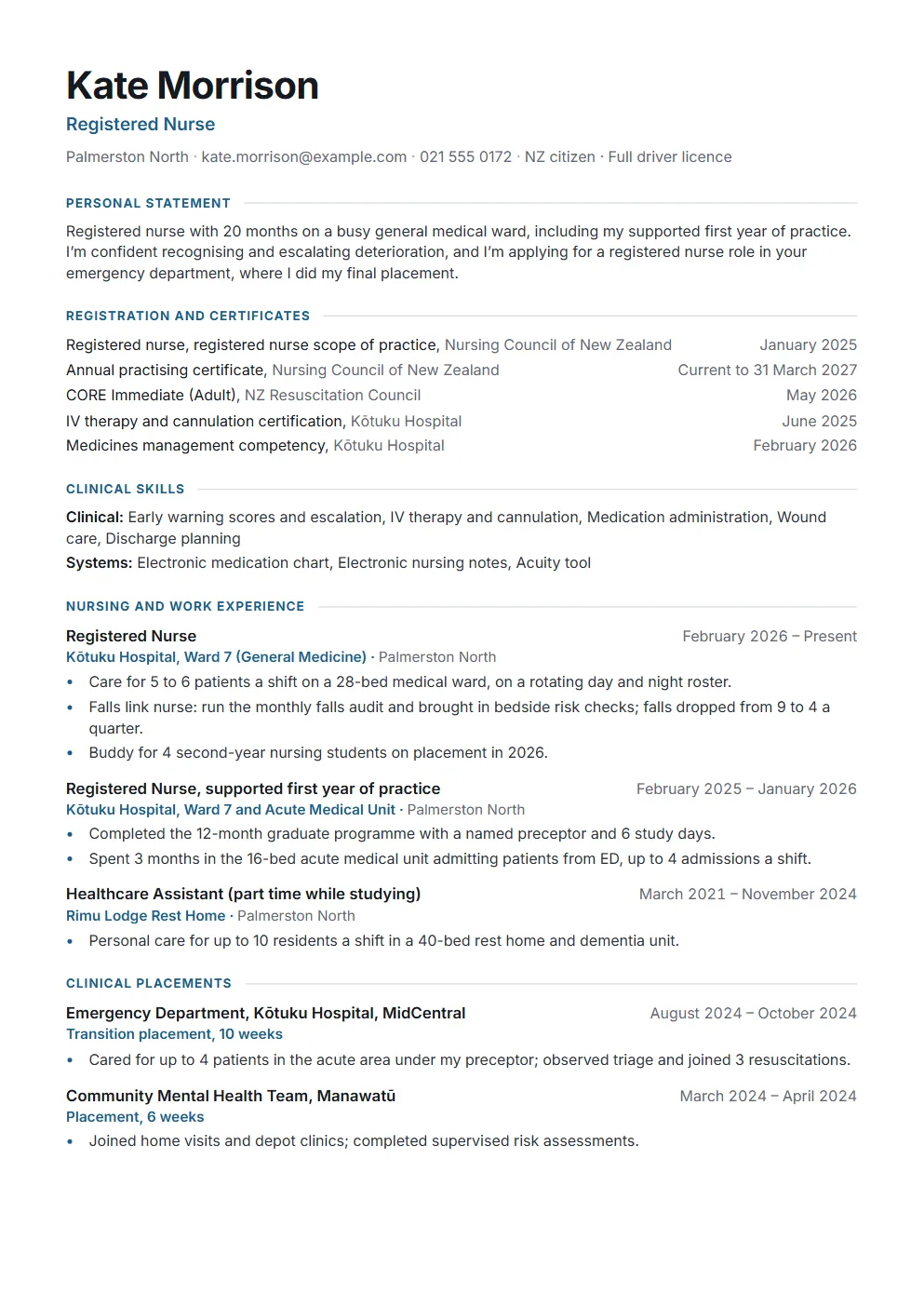
Nursing CV template for New Zealand
An A4 CV for registered nurses in New Zealand, whether you’re a new graduate applying through ACE, changing wards or services, or registering from overseas. Your Nursing Council registration and practising certificate sit straight under your statement, where a nurse manager will look for them.
- Word and PDF
- A4
- No sign-up, no watermark
What’s in it, in order
- Name, phone, email, work rights and driver licence
- Personal statement: your scope, your experience and the role you want
- Registration and certificates: Nursing Council registration, APC, resuscitation, IV and medicines
- Clinical skills, up to five, and the systems you use
- Nursing and work experience, including healthcare assistant roles
- Clinical placements: setting, organisation, region and weeks
- Education
- Professional development, including your PDRP level
- Two clinical referees
The blank template
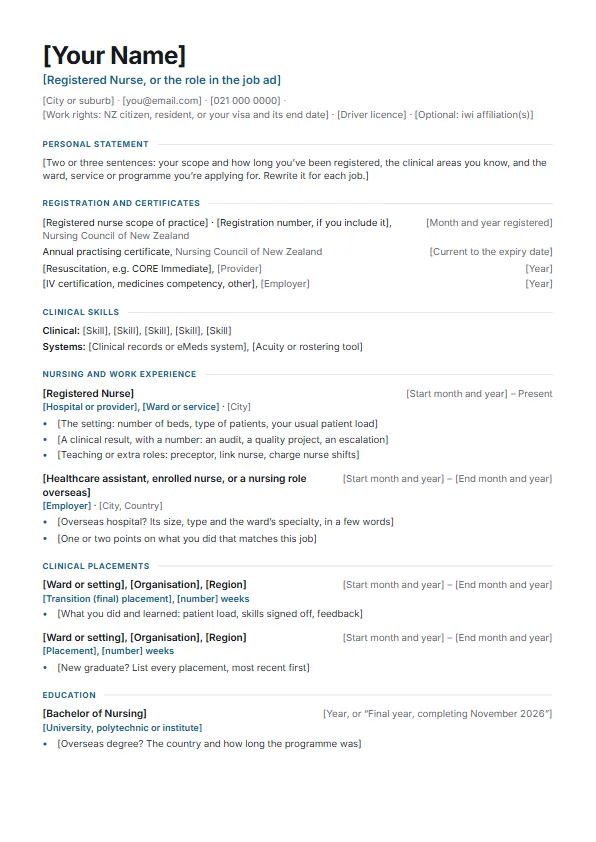 Template (Word)
Also available: the example as a Word file.
Already have a CV?
See your nursing CV in this layout
Upload or paste the CV you have now, whether it’s a student draft, a ward CV from here or one from overseas. In about 20 seconds it appears in this layout: A4, registration near the top, each page shown as it will print. Your wording is copied exactly and never rewritten. Save it to download a PDF or Word file, then check what a nurse manager will look for first: your APC date, your scope and your current certificates.
Updated October 2026. Sources are listed at the end.
Put registration and your APC near the top
You need a current annual practising certificate (APC) to practise as a nurse in New Zealand, and you renew it every year. The Nursing Council tells employers they must make sure their nurses hold one, and it runs an online register search for that check. A short section straight after your statement saves the reader hunting for it.
Write your scope (registered nurse scope of practice), the month you were registered and the date your APC runs to. APCs end on the last day of a quarter, set by your birth date, so “current to 31 March 2027” is the usual form. The ACE graduate CV template has a line for your APC number. No rule says it must go on a CV, and the employer checks the register either way, so it’s your call.
The Council can place conditions on a nurse’s scope that limit them to a set area of practice. If yours has one, say so in plain words rather than leave the employer to find it. If you’re authorised to prescribe, add that here too.
Then list the certificates the job ad asks for, with the year. For resuscitation, name the level: the NZ Resuscitation Council’s CORE Immediate is for responders who manage the first stages of a cardiac arrest, and CORE Advanced is for those expected to manage and supervise a resuscitation. IV certification and medicines competency are usually signed off by your employer, so name the employer. A new employer may ask you to repeat them.
New graduates: ACE, your first year and placements
ACE (Advanced Choice of Employment) is how final-year students and recent New Zealand nursing graduates apply for a supported first RN job. One application goes to up to three employers, and you rank up to five practice settings. There are two rounds a year, mid-year and end of year. To be eligible you must have studied in New Zealand, be a New Zealand citizen, permanent resident or Australian citizen, and not have worked as a New Zealand RN for three months or more in a row.
Names have changed. Health NZ now calls the graduate year the supported first year of practice (SFYP); ACE’s guide notes that employers may still say NETP. NESP is a separate 12-month programme for mental health and addiction.
ACE accepts PDF files only: your CV, proof of identity, your transcript or degree certificate, and up to three cover letters, one per employer. Its own CV template is optional, and it says using another format won’t count against you. Its guidance is still worth following:
- Two pages is ideal, three at most
- No more than five key skills
- Every clinical placement, most recent first, with the organisation, ward or setting, region and number of weeks
- Healthcare assistant or enrolled nurse jobs and relevant volunteering under work experience
- No school qualifications
- Iwi affiliation is an optional section; leaving it out won’t disadvantage you
Trained overseas: show where your registration is up to
The Council’s process starts with TruMerit checking your documents: identity, registrations held in the last 10 years, your nursing qualification, English language and 1,800 hours of practice since registering. You also complete Welcome to Aotearoa New Zealand, two free online courses on culturally safe nursing, and a criminal history check. Some registered nurses must also pass a competence assessment: an online theory exam, then a two-day orientation course and a clinical exam (OSCE) at Nurse Maude in Christchurch. The Council tells you if you need it. Nurses with a current Australian practising certificate apply under trans-Tasman mutual recognition instead.
On your CV, state your New Zealand status plainly, such as “Nursing Council registration: OSCE passed June 2026, application in progress”, and list your overseas registration with its country. Don’t write “RN” in a way that suggests you’re already registered here. For each overseas job, say in a few words what the hospital is, how many beds the ward had and your usual patient load, because a New Zealand reader won’t know the employer. ACE is for New Zealand graduates only, so apply to employers directly.
Show clinical skills through what you did
Every registered nurse does observations and gives medicines, so a long list of routine tasks doesn’t separate you. Choose the skills the ad names and prove them in your bullets: the size and type of the ward, your patient load, how you escalated a deteriorating patient, an audit you ran, the students or graduates you’ve supported.
The Council’s standards of competence, in force from 1 April 2025, are built on six pou: Māori health; cultural safety; whanaungatanga and communication; pūkengatanga and evidence-informed nursing practice; manaakitanga and people-centred care; and rangatiratanga and leadership. Te Tiriti o Waitangi runs through all of them. Show yours with facts that are true for you, like Te Tiriti or cultural safety training, work alongside Māori health or whānau support services, or care you planned with a patient’s whānau.
PDRP and professional development
To keep practising, you need at least 450 hours of practice and 60 hours of professional development in the past three years. A PDRP (Professional Development Recognition Programme) is an employer-run programme the Council approves. If your portfolio passes, you’re exempt from the Council’s recertification audit.
Health NZ now runs one national PDRP aligned to the 2025 standards. Its handbook describes Competent (meant for graduates at the end of their first year), Proficient, Expert and Designated Senior Nurse, with a new portfolio due every three years. Its policy names Proficient, Expert and Designated Senior Nurse as the recognised levels and treats every nurse with an APC as competent, so wording varies; other providers’ programmes may use other names, such as Accomplished. Write your level, the programme and when it’s next due.
Keep your PDRP certificate. Health NZ lets you transfer an approved PDRP from a previous employer until it expires, and asks for proof such as the certificate. NZNO notes that many collective agreements cover PDRP, and that nurses in former DHB settings are paid more for higher levels, so a current level matters at offer stage too.
Referees
For ACE, two referee reports are compulsory: one from the clinical tutor who supervised your final placement, and one from the preceptor on that placement. ACE requests them through its online form, so your CV doesn’t need a referees section, though you can add an employer or character referee. Ask each person before you name them.
Once you’re working, the usual pair is your current or recent charge nurse manager and a senior nurse who has seen your practice, such as a clinical nurse educator, associate charge nurse or preceptor. That’s common practice, not a rule; follow the job ad if it differs.
Mistakes to avoid
- Putting your registration and APC at the end of page two, or leaving out the date your APC runs to.
- Listing routine nursing tasks instead of the ward, patient load and results that show your level.
- As a new graduate, leaving out placements or the number of weeks each one ran.
- Calling yourself an RN with no country named when you trained overseas and New Zealand registration isn’t through yet.
- Listing a resuscitation certificate or PDRP level that has expired, or not saying when it was done.
- Uploading a Word file to ACE: it accepts PDFs only.
Questions
Should I put my Nursing Council registration number on my CV?
It’s up to you. The ACE graduate template has a line for your APC number, but no rule says it must be on a CV. Employers must check your APC is current either way, using the Council’s register.
How long should a nursing CV be in New Zealand?
ACE suggests two pages for graduates and no more than three. Two pages is enough for most experienced nurses too; cut older placements and jobs unrelated to nursing first.
What’s the difference between NETP, SFYP and NESP?
NETP was the long-standing name for the supported graduate year; Health NZ now calls it the supported first year of practice (SFYP), and some employers still use the old name. NESP is a 12-month entry programme in mental health and addiction. Graduates usually apply for all of them through ACE.
I trained overseas. Can I apply through ACE?
No. ACE is for people who studied nursing in New Zealand. Once you’re registered, or close to it, apply to employers directly and say on your CV where your registration is up to.
Do I keep listing clinical placements once I’m registered?
For your first year or two, yes, especially placements in the area you’re applying to. After that, most nurses keep only the placements that relate to the job, or drop them once their RN experience says more.
Sources
- Nursing Council of New Zealand: Annual practising certificates
- Nursing Council of New Zealand: Information for employers
- Nursing Council of New Zealand: Registered nurse scope of practice
- Nursing Council of New Zealand: Registered nurse scope and standards of competence 2025 (PDF)
- Nursing Council of New Zealand: Continuing competence
- Nursing Council of New Zealand: Approved PDRPs
- Nursing Council of New Zealand: Internationally qualified nurses
- Nursing Council of New Zealand: Competence assessment FAQs
- ACE Nursing: Eligibility
- ACE Nursing: How to apply
- ACE Nursing: FAQs
- ACE Nursing: Resources (CV template and 2026 applicant guide)
- Health NZ: Professional Development Recognition Programme for nurses
- Health NZ: Supported first year of practice for graduate registered nurses
- NZNO: Professional development
- NZ Resuscitation Council: CORE
General guidance. Always follow what the job ad asks for. Every name, employer and number in the example is made up.